The production of lithium-ion (Li-ion) battery cells involves three primary stages: electrode manufacturing, cell assembly, and cell finishing. Each stage consists of various sub-processes, starting with coating the anode and cathode, assembling components, and ultimately packing and testing the battery cells.
While prismatic, cylindrical, and pouch cells differ in design, their manufacturing processes are generally similar. Manufacturing constitutes roughly 25% of the total cost of a Li-ion battery. Key players in the production and supply of Li-ion cell manufacturing equipment include China, Japan, and South Korea.
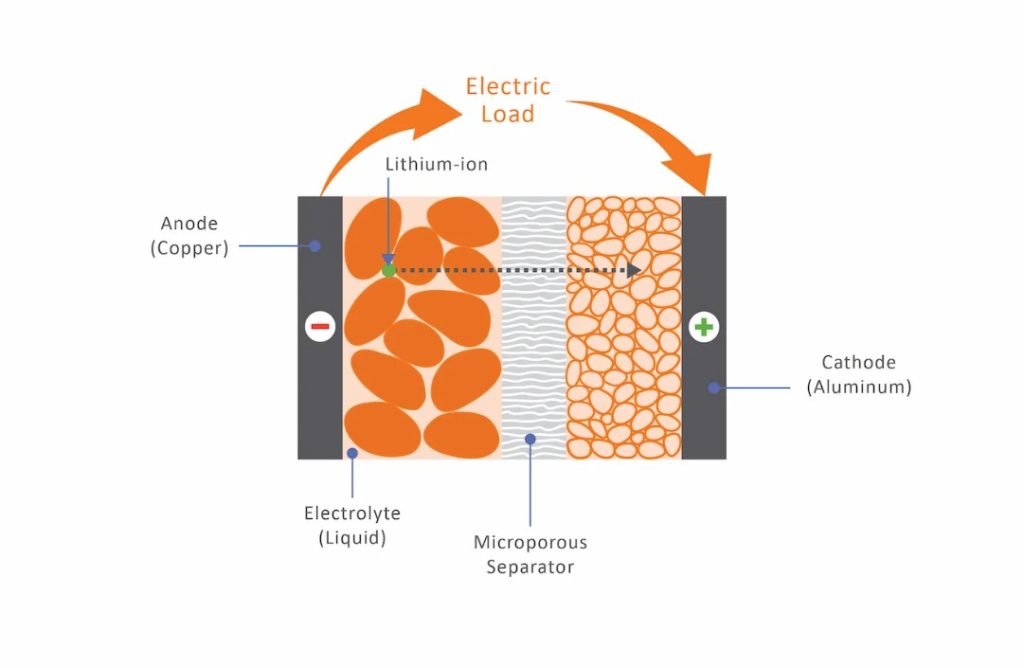
Components of Li-ion Cells
Li-ion cells consist of four main components:
⦁ Anode: Holds lithium ions when charged, typically made of graphite.
⦁ Cathode: Holds lithium ions when discharged, often an alloy of nickel, cobalt, lithium, and other metals.
⦁ Separator: Prevents direct contact and shorting between electrodes.
⦁ Electrolyte: Facilitates the movement of lithium ions between electrodes.
All components are encased with exposed tabs serving as positive and negative terminals. These cells are then connected to form a battery pack.
Manufacturing of Li-ion Battery
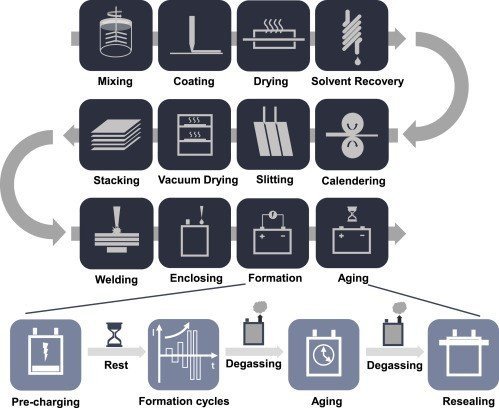
Stage 1: Electrode Manufacturing
Process:
- Slurry Mixing: Electrode materials are mixed with a conductive binder to form a uniform slurry with the solvent. The anode material is typically carbon, and the cathode is a lithium metal oxide. Anodes and cathodes are processed in separate rooms to avoid contamination.
Equipment: High-shear mixers and planetary mixers.
- Coating: The slurry is coated on both sides of the current collector (Al foil for the cathode, Cu foil for the anode) using tools like slot dies, doctor blades, or anilox rollers. The coating machine controls the electrode coating’s thickness.
Equipment: Coating machines, including slot die coaters and roll coaters.
- Drying: Coated foil is fed into a drying oven to evaporate the solvent. Flammable solvents from the cathode coating are recovered or thermally recycled, while harmless vapors from the anode coating are exhausted.
Equipment: Drying ovens with solvent recovery systems.
- Calendaring: The coated foils are compressed by rotating rollers to adjust physical properties such as bonding, conductivity, density, and porosity.
Equipment: Calendaring or roll pressing machines.
- Slitting and Drying: Finished electrodes are cut into strips, recoiled, and sent to a vacuum oven to remove residual moisture and solvent.
Equipment: Slitting machines and vacuum drying ovens.
Stage 2: Cell Assembly
Process:
- Sub-Assembly: Electrodes are layered with a separator in a dry room to form the cell’s internal structure. Stacking is used for pouch cells, while winding is used for prismatic and cylindrical cells.
Equipment: Die cutting machines, stacking machines (for pouch cells), and winding machines (for prismatic and cylindrical cells).
- Connection and Sealing: The cell structure is connected to terminals or cell tabs using ultrasonic or laser welding. The sub-assembly is then inserted into the cell housing and sealed, leaving an opening for electrolyte injection.
Equipment: Sealing and tab welding machines.
- Electrolyte Filling: The cell is filled with electrolyte using a high-precision dosing needle in a dry room to prevent decomposition. The cell is then sealed and labeled.
Equipment: Electrolyte filling machines.
Stage 3: Cell Finishing
Process:
- Formation: The first charge-discharge cycles form the Solid Electrolyte Interface (SEI) on the anode, which reduces self-discharge and improves performance.
Equipment: Battery formation testers.
- Aging: Cells undergo a period of high and normal temperature aging to monitor their characteristics and performance.
Equipment: Aging cabinets and storage shelves.
- Testing: Cells are tested for capacity, internal resistance, and other parameters before being assembled into battery packs.
Equipment: Grading machines and battery testing machines.
Innovation in Processes and Products
Technological advancements are driving down production costs and improving the performance and quality of Li-ion batteries. Key innovations include:
- Advanced Mixing Technologies: High-shear mixers, planetary mixers, and dispersers are now available, enhancing the uniformity and quality of the slurry mix.
- Simultaneous Coating: This process enables the coating of both sides of the foil simultaneously using two opposite application tools, increasing efficiency.
- Dry Coating Applications: Active materials can be applied in powder form without using a solvent, greatly reducing thermal activation time. This eliminates the need for solvents and the drying process, making large-scale production more economical.
- Infrared-Supported Dryers: Conventional dryers can be supported by infrared heating, making them more efficient and reducing energy consumption.
- Lamination Technology: Individual electrode and separator sheets are laminated in a continuous process and then pressed together by a heat press. This technology improves production line speed and product consistency.
These innovations contribute to more economically viable large-scale Li-ion battery production, benefiting both manufacturers and consumers.